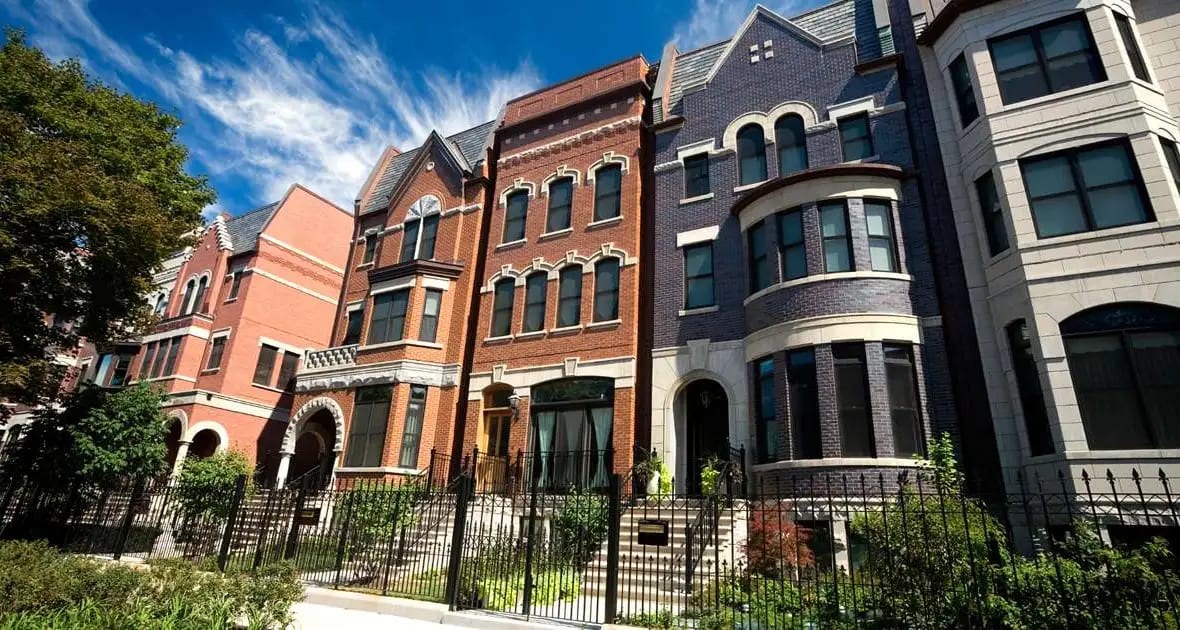

From stately mansions to charming row homes, Chicago’s historic districts offer a window into the city’s rich architectural and cultural heritage. These neighborhoods capture the stories of a city constantly evolving – one façade, foundation and front porch at a time. Here’s a look at four historic districts that stand out for their beauty and significance – and just might inspire your next move.

Image credit: Choose Chicago
Alta Vista Terrace District: Chicago’s Little London
Tucked just off Graceland Cemetery in Lakeview, Alta Vista Terrace feels like a hidden storybook land, and that’s by design. Developed in 1904 by Samuel Gross, this single-block stretch features 40 nearly identical row homes inspired by London’s Georgian architecture. Each residence was modeled after a different English design, showcasing details like Palladian windows, decorative gables, and columned porches.
What makes Alta Vista especially intriguing isn’t just its whimsical charm; it’s the neighborhood’s sense of timelessness. Despite being over a century old, it remains remarkably intact, a testament to preservation and local pride. The district was designated a Chicago Landmark in 1971, and today it’s one of the city’s most coveted enclaves for buyers seeking historic character with urban convenience.

Image credit: Chicago Magazine
Hutchinson Street District: Prairie School Showcase
Hutchinson Street in Uptown’s Buena Park is home to one of the finest collections of Prairie School and early 20th-century architecture in the city – thanks to George W. Maher. A contemporary of Frank Lloyd Wright, Maher designed many of the homes along Hutchinson Street, blending Prairie School sensibilities with his signature motifs: strong horizontal lines, expansive porches, and stylized floral ornamentation.
Designated a historic district in 1977, Hutchinson Street is a living gallery of early 20th-century residential design. Some homes have even been featured on national architectural tours. It’s not just the architecture that impresses – it’s the quiet, tree-lined setting, just steps from Lake Michigan, that makes this area feel like a peaceful retreat within the city.

Image credit: National Park Service
Bronzeville-Black Metropolis National Heritage Area: Legacy of Culture and Power
Bronzeville isn’t just a neighborhood; it’s a cornerstone of Black American history. The Bronzeville-Black Metropolis National Heritage Area encompasses several early 20th-century buildings tied to Chicago’s Great Migration era, when African Americans moved north seeking opportunity and built a thriving, self-sustaining community here.
From the Overton Hygienic Building, a hub of Black entrepreneurship, to the Ida B. Wells-Barnett House, home to the iconic journalist and activist, every corner echoes with stories of resilience, innovation, and influence. Bronzeville’s legacy also includes cultural contributions – from the origins of Chicago jazz to historic churches that served as community anchors. Today, Bronzeville is experiencing a renaissance, with new developments alongside restored landmarks.

Image credit: E-atlas
Prairie Avenue District: Where Chicago’s Elites Once Lived
In the late 1800s, the South Loop’s Prairie Avenue was the most prestigious address in Chicago. Here, the city’s industrial titans like Marshall Field, George Pullman, and Philip Armour built grand mansions that rivaled those on the East Coast. The neighborhood was considered Chicago’s original Gold Coast.
Although many of those homes were lost to time and urban development, several key properties remain, including the Glessner House and Clarke House Museum. Both offer public tours and are rich with insight into the lives of Chicago’s upper crust during the Gilded Age.
Today’s Prairie Avenue District blends the past with the present. High-rises and townhomes have joined the stately survivors, creating a unique mix of historic elegance and modern living.
WRITTEN BY BELLA PAREDES for @properties Christie’s International Real Estate